Posts

The Bhagwad Gita said: Nothing is Permanent

Image
Nothing is Permanent  " The only thing constant in life is “Change”- Today you might be rich and famous. Tomorrow fame and fortunate both might be gone. Accept both situations with equanimity. Season changes, people change, day follows night, etc. learn the lesson of change from Mother Nature. Changes in life make you resilience and show you how to be tenacious."  Apply this principle in your Life to live life according to the  Bhagwat Gita .  

Lesson form The Bhagwat Gita to reduce your anxiety and stress about the future

Image
Why Worry? Be Happy Learn to take life as it comes. Learn to get over it. Whatever you are moping about, just forget about it. A job interview that did not go as planned or the relationship you were hoping, but it did not work out. You need to take things in your stride. Let go and have faith that everything happens for a reason. You cannot control the past nor can you control the future. You only have the present so learn to live it up to the fullest.  Embrace this  Bhagwat Gita  to reduce your anxiety and stress about the future.

Teachings of the Bhagavad Gita

Teachings of the Bhagavad Gita   “Life in the world alone leads to one result, meditation alone leads to another. So have we heard from the wise.”

Lord Siva said to Parvati---

Image
Lord Siva said to Parvati---  There is no asana like Siddha, no force like breath retention, no mudra like Khechari, and no laya like nada (The Siva Samhita 5:47).

The Sukhasana Pose Yoga

Image
  "This is also called Sukhasana, the easy asana. It destroys all suffering. Svastikasana is the best for making one healthy and is to be kept secret by yogis.” - (Siva Samhita 3:115) The Sukhasana pose is a simple yoga asana, typically performed as a warm-up starting pose or finishing pose during yoga practice. To perform Sukhasana while seated, firmly plant your buttocks on the floor and cross your legs over one another. You can use a squat to transition from the simple seated pose to a standing pose to help you remain balanced while you gently pull yourself into a standing position. The gentle nature of the Sukhasana pose makes it an easy alternative to the lotus pose, which yogis with tight hip joints and muscles may find more challenging. While yoga instructors often teach Sukhasana or cross-legged positions as part of a series of asanas, it's also an ideal pose when performed on its own during  meditation  sessions or periods of quiet reflection. When yoga teachers ...

KUKKUTASANA (Cockerel Pose)

Image
 KUKKUTASANA (Cockerel Pose) Assuming padmasana, insert the hands between the thighs and calves, planting them (the hands) firmly on the ground, raise the body in the air. This is kukkutasana (HYP 23 ). Kukkutasana is one of the advanced yoga postures and is also known as Cockerel Pose or Yoga Rooster Pose. The word Kukkutasana comes from Sanskrit, where ‘Kukkut’ means cock or rooster and ‘Asana’ means pose. Kukkutasana is commonly found in you sequences such as Ashtanga Yoga, Iyengar Yoga, Core Yoga, or Hip Opening Yoga Sequences. It is a great posture to add to your home workouts. While considered an advanced yoga posture, mastering Kukkutasana requires some amount of time and practice making it a great asana to try in yoga for beginners. Technique  of Kurmasana Sit in padmasana. Insert the right arm between the right thigh and calf muscle, and the left arm between the left thigh and calf muscle. Place the palms of the hands firmly on the ground with the fingers pointing for...

KOORMASANA (Tortoise Pose) in Hath Yoga Pradipika

Image
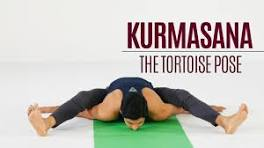
 KOORMASANA (Tortoise Pose) Press the anus firmly with the ankles in the opposite direction and sit well-poised. According to the yogis this is koormasana (Hath Yoga Pradipika 22).  The Kurmasana is considered a posture that can connect your inner self with the spiritual ones. It enhances the flexibility of the back, hips, neck and shoulders. Furthermore, it also withdraws distractions and keeps your nerves calm. The Tortoise Pose is beneficial for certain muscles, like the lower and upper back, core abs, biceps and triceps, hamstrings, hips, pelvis, neck and quadriceps. So, if you include this posture with other asanas that focus on the same muscles, you can extract more health benefits. Technique of Kurmasana Sit on the ground and spread the legs out to the sides as much as possible. Exhaling, lean forward, bend the knees and slip the arms under the knees, taking the hands back behind the buttocks. Bring the forehead down to the ground. Breathe normally in the final position...