New Released Book: Pandit Nehru and the RSS: Competing Visions of Nation, Culture, and Modernity in India
Pandit Nehru and the RSS: Competing Visions of Nation, Culture,
and Modernity in India
Sale!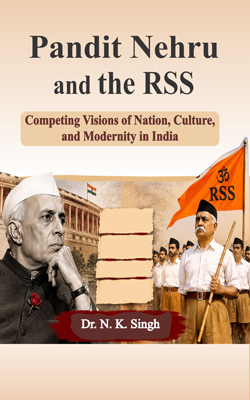
This book examines these competing visions as historical forces that shaped institutions, public discourse, and political practice from the late colonial period through the early decades of the Republic. It traces Nehru’s response to the Sangh and the Sangh’s subsequent adaptation, consolidation, and expansion. Both projects are situated within their broader intellectual and organisational contexts: the composite nationalism of the freedom struggle and the constitutional settlement of 1950 on one side; the longer tradition of Hindu organisational politics and civilisational thought on the other. This study does not seek to adjudicate the contest. Its purpose is more modest and more necessary: to recover the substance of the arguments, to clarify what was at stake, and to show how two powerful and enduring ideas of the nation have shaped modern India.
Pandit Nehru and the RSS: Competing Visions of Nation, Culture, and Modernity in India
₹1,450.00
| Author | : | Dr. N.K. Singh |
| ISBN | : | 978-93-49522-45-9 |
| Edition | : | 1st |
| Year | : | 2027 |
| Size | : | 13×18 Cm |
| Page | : | 224 |
| Price | : | INR 1600 |
| Subject | : | Political Science |
About the Book
The contest between Jawaharlal Nehru and the Rashtriya Swayamsevak Sangh remains one of the central and unresolved arguments of modern Indian history. It was never merely a dispute between individuals or parties. It concerned the foundational questions of the Indian nation: what constitutes the national community, what role culture and religion should play in public life, and what form of modernity independent India ought to pursue. Nehru advanced a vision of civic nationalism anchored in the Constitution, equal citizenship, scientific temper, and a secular state that sought to stand above religious identities. The RSS, by contrast, offered a cultural-nationalist conception in which Hindu civilisation formed the organic core of the nation.This book examines these competing visions as historical forces that shaped institutions, public discourse, and political practice from the late colonial period through the early decades of the Republic. It traces Nehru’s response to the Sangh and the Sangh’s subsequent adaptation, consolidation, and expansion. Both projects are situated within their broader intellectual and organisational contexts: the composite nationalism of the freedom struggle and the constitutional settlement of 1950 on one side; the longer tradition of Hindu organisational politics and civilisational thought on the other. This study does not seek to adjudicate the contest. Its purpose is more modest and more necessary: to recover the substance of the arguments, to clarify what was at stake, and to show how two powerful and enduring ideas of the nation have shaped modern India.
About the Author
Dr. N.K. Singh, 35 years research experience on Oriental Religion and Philosophy, has written several books on religion, philosophy and its allied subjects. He did his Ph.D. from Patna University, Patna. His works, especially on oriental studies initiated considerable interest on Buddhism, Hinduism and Islam, carrying high appreciation from scholars of Buddhist and Islamic countries. Presently, he is the Director of International Centre for Religious Studies, Delhi and Chief Editor of Global Religious Vision: a quarterly Research Journal since 1999. In 2000, he established the publishing house known as Global Vision Publishing House in Delhi for promoting research culture among Indian youth.


Comments
Post a Comment